EDITORIAL
The article presents the consolidated position of leading national medical research centers on the current state and development priorities of cardiological care in the Russian Federation. In recent years, the federal project “Fighting Cardiovascular Diseases” has created a platform for modernizing care for patients with cardiovascular diseases: the infrastructure of regional vascular centers and primary vascular units has been upgraded, patient routing has been improved, access to endovascular and cardiac surgical interventions has expanded, an outpatient drug‑supply framework has been established, dispensary follow‑up has been strengthened, and the practical implementation of digital tools for quality management has begun. The next stage in the development of the service is associated with shifting the focus from responding to established vascular catastrophes to continuous cardiovascular risk management, including early detection of dyslipidemias, subclinical atherosclerosis, and genetically determined high‑risk factors such as lipoprotein(a). Special emphasis is placed on to continuity of care across levels of medical services, the organization of dispensary follow‑up, and the role of clinical practice guidelines, clinical decision support services, electronic medical records, registries, and remote monitoring.
BEST PRACTICES OF THE REGIONS IN THE FIELD OF A HEALTHCARE ORGANIZATION
The Far Eastern Federal District (FEFD) is one of the largest federal districts of the Russian Federation and is characterized by considerable distances and limited accessibility of a number of settlements. These features require specific organizational approaches to the provision of medical care for patients with cardiovascular diseases.
Aim. To present a model for organizing high-technology cardiac surgical care at the Federal Center for Cardiovascular Surgery, Khabarovsk (FCCS), and to assess the role of the FCCS in ensuring access to planned, free-of-charge high-technology medical care for residents of the FEFD.
Materials and methods. The study was based on an analysis of annual analytical reports of the FCCS, reports from the constituent entities of the FEFD submitted to the chief external cardiovascular surgeon of the FEFD, data from the federal and regional telemedicine system for remote consultations, and open official statistical materials for 2011–2025.
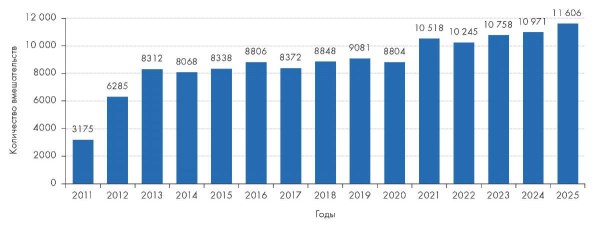
Results. Since the opening of the FCCS, there has been a steady increase in the number of surgical operations and diagnostic procedures. The number of surgical interventions increased from 3,175 in 2011 to 11,606 in 2025. Over the past five years, both the mean age of admitted patients and the complexity of clinical cases have increased. Owing to organizational measures and the introduction of new technologies, hospital and postoperative mortality rates decreased from 1.0 and 1.1 % in 2013 to 0.38 and 0.43 % in 2025, respectively, despite the growing complexity of clinical cases. The following organizational and technological solutions were introduced and adapted: daily multidisciplinary consultations based on the heart-team approach; adaptation of the medical information system “Medialog”; telemedicine consultations; remote patient selection and routing; development of a quality management system; a patient-centered approach; adaptation and development of high-technology medical care methods; and import substitution of consumables and technical solutions.
Conclusion. The presented solutions improved the accessibility and quality of specialized high-technology care for patients with cardiovascular diseases in the FEFD, despite the increasing complexity of clinical cases and the territorial characteristics of the federal district.
ORGANIZATION OF MEDICAL CARE. THE EXPERIENCE OF THE REGIONS
Oncologic and cardiovascular diseases frequently coexist, increasing perioperative risk and worsening long‑term outcomes in cancer patients. At the same time, optimal approaches to integrating cardiac and endovascular interventions into the care pathways of patients with malignancies and severe cardiac comorbidity remain insufficiently defined.
Aim. To evaluate the effectiveness of a cardio‑oncology care model based on staged and simultaneous surgical correction of cardiovascular pathology in cancer patients.
Materials and methods. A single‑center retrospective study included 678 patients with malignant neoplasms and concomitant cardiovascular diseases who underwent cardiovascular interventions at N.N. Blokhin National Medical Research Center of Oncology of the Ministry of Health of the Russian Federation between 1991 and 2026. The organizational model comprised a three‑step algorithm: primary cardiac screening, extended cardiologic work‑up with risk stratification, and subsequent selection of staged or simultaneous strategies at a multidisciplinary tumor board.
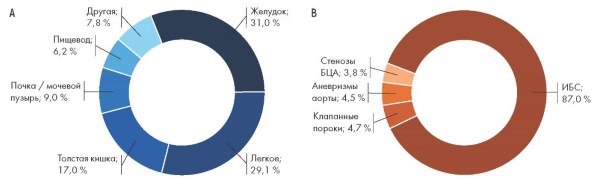
Results. Most patients had coronary artery disease (87 %), whereas valvular heart disease, aortic aneurysms, and hemodynamically significant lesions of the brachiocephalic arteries were less common. Coronary angioplasty with stenting was performed in 56.3 % of cases and coronary artery bypass grafting in 25.8 %; overall, 67 % of procedures were minimally invasive or endovascular. A staged strategy was used in 93.4 % of patients and a simultaneous one in 6.6 %. In the reference cohort of 124 radically operated patients with severe cardiovascular comorbidity, the overall complication rate and in‑hospital mortality were 55.3 % and 4.1 %, respectively; the incidence of major cardiovascular complications was 6.5 %, with a 3.2 % mortality from these events. In the long term, tumor progression was the leading cause of death, whereas the proportion of cardiovascular events was substantially lower; overall survival was comparable to that of patients without severe cardiac pathology.
Conclusion. A comprehensive cardio‑oncology care model incorporating active surgical correction of cardiovascular disease, broad use of minimally invasive and simultaneous procedures, and multidisciplinary decision‑making allows expansion of indications for radical cancer treatment while maintaining acceptable short‑ and long‑term outcomes in patients with pronounced cardiovascular comorbidity.
INFORMATIZATION OF HEALTHCARE
Aim. To evaluate the effectiveness of the MediSimo remote monitoring platform in the management of patients with arterial hypertension (AH) aged 60 years and older in outpatient practice.
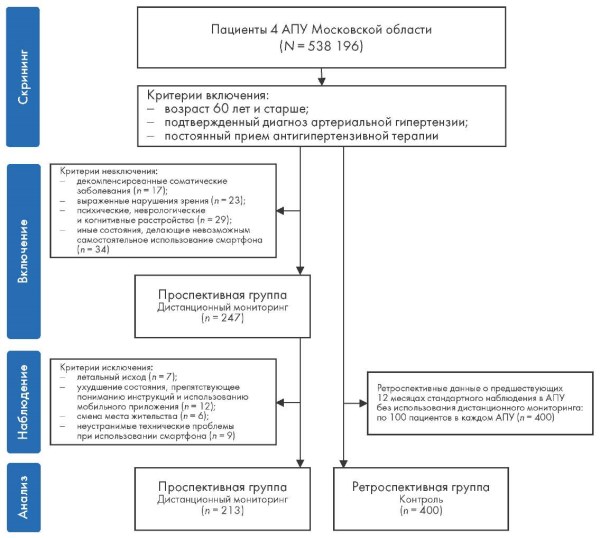
Materials and methods. A prospective study was conducted with the formation of a retrospective control group. The main group included 247 patients, of whom 213 completed 12 months of follow-up using remote monitoring. The control group consisted of 400 patients receiving standard care. Clinical and demographic characteristics, parameters of antihypertensive therapy, blood pressure (BP) levels, treatment adherence assessed by the Morisky–Green scale (MMAS-4), as well as the frequency of outpatient visits, hospitalizations and telemedicine consultations per patient per year were evaluated.
Results. Baseline characteristics of the groups were comparable in terms of key demographic and clinical parameters. After 12 months, the remote monitoring group demonstrated a reduction in systolic BP by 7 mmHg (p < 0.05) and an increase in the proportion of patients with target BP < 130/80 mmHg from 33.3 % to 78.4 %, whereas no significant changes in BP were observed in the control group. Treatment adherence improved (MMAS‑4 median increased from 2 to 3 points; p < 0.05). Optimization of antihypertensive therapy was noted, including a decrease in the proportion of monotherapy and increased use of combination regimens and once-daily medications. The frequency of outpatient visits and hospitalizations decreased approximately twofold, while the number of telemedicine consultations increased 2.8-fold. The proportion of patients who underwent preventive medical examinations and achieved clinically significant weight loss also increased.
Conclusion. Remote monitoring using the MediSimo platform in older patients with AH is associated with improved BP control, enhanced treatment adherence and more rational use of outpatient and inpatient resources through a reduction in face-to-face visits and hospitalizations alongside an increased share of telemedicine consultations.
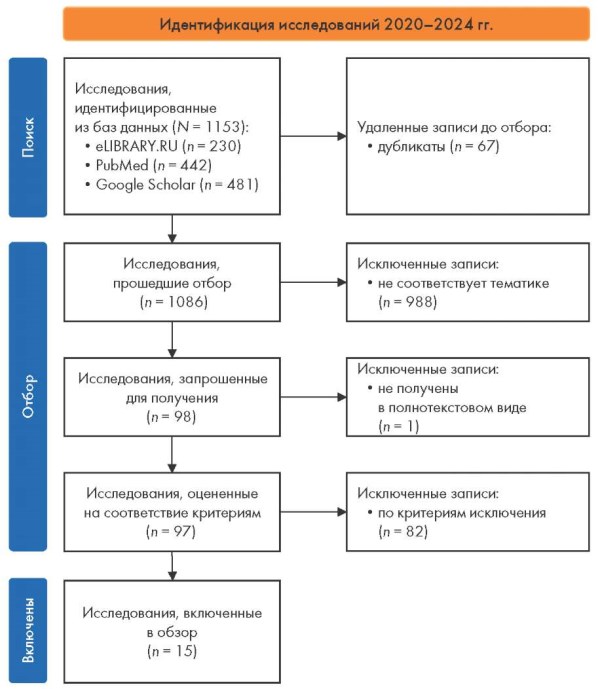
Aim. To identify and evaluate the effectiveness factors of mobile health (mHealth) use in the primary prevention of noncommunicable diseases (NCDs) among working-age individuals.
Materials and methods. The review included studies in Russian and English from eLIBRARY.RU, PubMed, and Google Scholar, published between 2020 and 2024. A total of 15 articles were included in the final analysis. Most studies (66.7 %) were designed as randomized clinical trials with participants divided into an experimental group (using mHealth) and a control group (without mHealth). The total number of participants was 11,273 people, mean age – 37.5 ± 8.0 years, follow-up period ranged from 1 to 12 months.
Results. mHealth technologies included web portals and mobile applications (40.0 %), e-mail and SMS (13.3 %), wearable devices (6.7 %), as well as their combinations (40.0 %). The effectiveness of mHealth compared to standard preventive care was positive in 80 % of studies and comparable in the remaining ones. The most convincing results were obtained in body weight reduction (26.7 %), increased physical activity and motivation (33.3 and 20.0 % accordingly), improved dietary habits and reduced waist circumference (20.0 % each), increased screening adherence, as well as smoking cessation and reduced alcohol consumption. Key success factors included personalization, interactivity, multicomponent interventions, and integration with routine healthcare practice. The main barriers were digital inequality, digital fatigue, limited evidence base for some outcomes, and data confidentiality issues.
Conclusion. mHealth has demonstrated effectiveness comparable to traditional preventive interventions, and in some indicators superior to them. However, high heterogeneity of study designs and differences in follow-up duration limit the possibility of meta-analysis. Standardization of protocols, assessment of long-term clinical outcomes and cost-effectiveness, as well as the development of strategies for adapting mHealth solutions to the Russian population are necessary.
МEDICAL EDUCATION
Insufficient physician’s knowledge of antithrombotic therapy (ATT) may lead to prescribing errors and an increased risk of adverse events.
Aim. To assess current competencies of physicians from different specialties in ATT and to analyze the most frequent errors.
Materials and methods. A cross‑sectional anonymous survey of 667 physicians from eight federal districts of the Russian Federation was conducted. The questionnaire comprised 22 items grouped into three domains: basic aspects of ATT, knowledge of clinical guidelines, and management of complex clinical situations. Knowledge was considered “sufficient” if ≥ 70 % of answers were correct. Odds ratios (ORs) and 95 % confidence intervals (CIs) were calculated.
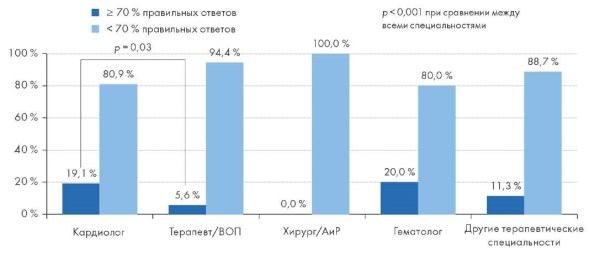
Results. A sufficient level of knowledge across all ATT domains was demonstrated by 14.8 % (n = 99) of respondents. Higher odds of having sufficient knowledge were observed in physicians with an advanced academic degree (OR 1.62; 95 % CI 1.02–2.57; p = 0.043), cardiologists (OR 3.45; 95 % CI 1.94–6.12; p < 0.001) and hospital‑based physicians (OR 2.01; 95 % CI 1.26–3.19; p = 0.004), whereas age and length of service had no significant effect. The proportion of physicians with sufficient knowledge was 20.0 % among haematologists, 19.1 % among cardiologists, 11.3 % among other internal medicine specialists, and 5.6 % among internists/general practitioners; no such respondents were identified among surgeons and anesthesiologist-intensivist (p < 0.001). Interregional differences in the proportion of physicians with sufficient knowledge did not reach statistical significance (p = 0.072). Sufficient knowledge of basic ATT issues was found in 72.7 %, of clinical guidelines in 30.4 %, and of complex ATT‑related questions in 4.4 % of respondents.
Conclusion. This pilot study revealed an overall insufficient level of physician competencies in the prevention and treatment of thrombosis, particularly regarding knowledge of clinical guidelines and ATT use in complex clinical scenarios. The findings support the need to develop and implement targeted educational programs on ATT for physicians of various specialties.

ISSN 2713-0703 (Online)